Scalenut Review: the Ultimate Content Creation Tool
In the rapidly evolving landscape of the SEO industry in 2024, Scalenut has emerged as a prominent tool garnering considerable attention. Eager to explore its capabilities firsthand, I embarked on a journey to unravel its value proposition. In this comprehensive Scalenut review, I delve into its features with an objective lens, drawing from my own usage experience and presenting actual output examples to provide a nuanced understanding of its capabilities.
Read our Scalenut review to learn about its AI-powered content creation tools, user interface, pricing, and performance for optimizing your content strategy.
What is Scalenut?
Scalenut stands out as a comprehensive digital marketing tool designed to streamline the complexities of search engine optimization using cutting-edge AI technology. By integrating functions like keyword research, content clustering, article drafting, on-page optimization recommendations, and analytics tracking into a unified platform, Scalenut offers a holistic solution for users at various stages of their SEO journey.
Whether you’re a novice navigating the intricacies of SEO or an experienced practitioner seeking to amplify your strategies, Scalenut presents an opportunity to expedite research efforts while enhancing your search rankings through intelligent insights derived from your content and real-time competition analysis in search engine results.
Scalenut’s benefits
| Scalenut’s benefits | Details |
|---|---|
| Traffic growth | By streamlining your content production and search optimization, Scalenut aims to help you increase organic traffic to your website over time. |
| Quality SEO content | Its AI writing assistant saves you research and drafting hours while ensuring your topics are thoroughly covered to meet reader needs. |
| Topical authority | Regular publishing of keyword cluster-based content supported by Scalenut’s SEO audits can help you build EEAT and become a leader in your chosen industry verticals. |
| Data-driven strategy | Scalenut analyzes your site’s analytics and compares it to top-ranking competitor content in search results, aiming to help you create more optimized articles that resonate better with Google’s algorithm and your target audience. |
Who is Scalenut for?
Scalenut caters to a diverse range of users within the SEO landscape, including:
• Content creators and bloggers aiming to streamline research and drafting processes while receiving SEO recommendations for improved ranking.
• SEO specialists and consultants overseeing client projects or extensive portfolios, benefitting from centralized reporting and structured optimization insights.
• Brand executives seeking to enhance organic traffic and evaluate the effectiveness of content marketing efforts in terms of ROI.
• Marketing agencies managing keyword strategies, content creation, and on-page optimization across multiple client accounts, leveraging Scalenut’s comprehensive suite of tools and features.
Scalenut features
After diving into Scalenut’s features and exploring its potential user base, the question remains: does it deliver on its promises?
To answer this, we’ll need to delve deeper into its functionality, examining how effectively it streamlines SEO tasks, provides actionable insights, and contributes to improved rankings and organic traffic. Additionally, we’ll want to assess user feedback and real-world case studies to gauge its performance in various scenarios.
Stay tuned as we uncover whether Scalenut lives up to its ambitious goals and delivers tangible results for its users.
Let’s go feature-by-feature and see how it actually performs.
1. Keyword Planner
Starting with the Keyword Planner is a natural approach for testing SEO tools, offering insight into their main focus. In the case of Scalenut, it became evident that its core feature is AI content generation, with keyword research serving as a supporting tool. This can streamline the research process and empower the AI writer with more data to work with, potentially saving users significant time each week.
For this review, I selected the keyword “how to become zero waste,” although Scalenut advised against using questions as seed keywords. Instead, I inputted the broader keyword “zero waste lifestyle.”
The planning process took less than a minute, slightly slower than non-AI keyword research tools like Keysearch but comparable to or faster than other AI-powered SEO tools such as MarketMuse. Once completed, users need to click “Open Report” to view the results. Scalenut also sends email notifications when keywords are ready, although some users may find these emails bothersome and opt to auto-trash them if unsubscribing isn’t an option.
2. Article Writer
Scalenut initially caught my attention as an SEO tool, but I was surprised to discover its significant focus on AI article generation. This comprehensive approach seems aimed at establishing Scalenut as an all-in-one SEO suite.
For those specifically interested in its AI writing capabilities, I’ll delve into how it operates and the quality of the results it produces.
Navigating to the Article Writer section in the side menu directs you to a folder containing previously generated articles, with a straightforward creation form at the top. Here, you can input your target keyword along with any secondary keywords you’d like to include in the article.
Scalenut offers the option to compete with the top 10, 20, or 30 search results, tailoring the editor based on insights from the current search results. Given that most users prioritize the top 10 results, this option aligns well with user needs.
Upon clicking “Create,” it impressively takes only 10-15 seconds to generate an editor, ranking among the fastest tools I’ve encountered. A new item appears in the list with the status “Ready for writing,” which, when clicked, leads to Cruise Mode—a step-by-step process for generating an article with AI. However, users can opt to skip to the Editor at any point and manually handle the process if desired.
3. Content Optimizer
If you’re in search of an effective AI content optimization tool to enhance your content’s visibility in search results, Scalenut is worth considering.
The process is straightforward: simply input your target keyword and country, then hit “Optimize.” Scalenut analyzes the top 10, 20, or 30 search results (depending on your preference) and generates an empty editor with guidelines and NLP-based keywords aimed at improving your chances of ranking higher.
Alternatively, if you already have a published article, you can input the URL, and Scalenut will compare your content to currently ranking pages. However, the suggestions provided may vary in usefulness. For instance, some recommendations—such as reducing the length of a detailed guide—may seem impractical. Nonetheless, keyword-based suggestions often make sense.
The editor, accessible after creating a new article with Cruise Mode, features three tabs:
1. The “Optimize” tab provides specific on-page SEO suggestions, covering elements like headings, content depth, keyword density, and meta tags. It even offers insights on potential featured snippets.
2. The “Research” tab offers a list of common terms found in ranking articles, along with usage frequency and examples from competitor pages. These numbers update in real-time as you edit, allowing you to monitor your progress.
3. The “Statistics” tab, while intriguing, seems to extract sentences containing facts or numbers from competitor articles. This feature, though not universally appreciated, offers a unique perspective on content optimization.
Moreover, the “AI Templates” tab provides additional resources for enhancing your article, a topic I’ll delve into further in the Marketing Copywriter section below.
Overall, while Scalenut may not be the top choice for content optimization (with alternatives like Neuronwriter being favored), it’s worth experimenting with its guidelines to gauge any impact on search rankings.
4. Traffic Analyzer
Another noteworthy feature that SEO-focused businesses may find beneficial is Scalenut’s traffic analyzer. This tool allows users to integrate their Google Search Console data directly into the Scalenut app, eliminating the need to switch between platforms.
Functioning similarly to Google Search Console, Scalenut’s traffic analyzer presents insights such as traffic volume, impressions, average SERP position, and click-through rates. Additionally, it highlights keywords that have recently gained or lost traction, along with corresponding ranking data.
In essence, the traffic analyzer aggregates website data from Google and presents it in a more streamlined manner. However, while it offers convenience by centralizing data within the Scalenut interface, it doesn’t provide any unique functionalities beyond what is available in the Search Console.
Ultimately, the traffic analyzer serves as a convenient alternative for users who prefer Scalenut’s interface over that of the Search Console. If you’re comfortable with sharing your data with a third-party tool and seek to streamline your SEO workflow, this feature can help save time by minimizing the need for context switching between platforms.
5. Marketing Copywriter
The final feature I’ll delve into in this Scalenut review is the Marketing Copywriter. This feature functions as an all-in-one AI assistant, akin to those found in many other AI writing tools like Writesonic.
Users have the option to start with one of the forty pre-built templates or begin with a blank document and access the templates at any point during the writing process. The Marketing Copywriter can assist with various marketing tasks, ranging from copywriting to social media marketing to crafting product descriptions for e-commerce platforms.
Some noteworthy templates include:
• Product feature lists
• Product descriptions
• Blog outline creator
• Active to passive voice converter (and vice versa)
• Customer review responder
• Video script outlines
• Business name generator
• Summary generator
• Compelling bullet points
• Quora answers
• Sales email generator
• LinkedIn ad descriptions
While I haven’t extensively tested all of these templates, I did experiment with the social media post creator. In my experience, two out of three versions generated were deemed acceptable and suitable for a tweet-style post that a brand might utilize.
Other things I like about Scalenut
1. Helpful tutorials
Introducing a new tool into your business routine can often be a daunting process, but Scalenut strives to make onboarding as smooth and effortless as possible.
Upon accessing the Dashboard, users are greeted with an overview of all the main features of the app. Each section includes a “How it works” button, which directs users to a brief 2-4 minute video outlining the functionality of that tool and providing tips on maximizing its utility.
Additionally, tutorial videos are embedded on each feature page outside of the dashboard, typically located in the top right corner. This ensures that users have access to guidance on how each feature operates, simplifying the learning curve associated with using Scalenut.
This approach proves invaluable not only during the initial stages of using Scalenut but also as a helpful reminder for users to periodically revisit features and ensure they are fully leveraging the capabilities of the platform.
2. Plagiarism checker
If you’re a Copyscape user, you’ll be pleased to know that Scalenut offers seamless integration with the platform, allowing you to check plagiarism scores without the hassle of switching between apps.
To activate this feature, simply navigate to your profile avatar located in the top right corner of the interface, and select “App Integrations.” From there, choose “Plagiarism Checker” and click on “Connect.” You’ll be prompted to enter your Copyscape API key, which is available to premium Copyscape users.
While personally, I already utilize Grammarly, having the option to seamlessly integrate Copyscape for quick plagiarism checks is certainly convenient and saves the hassle of manually copying and pasting content for verification.
3. WordPress integration
In the “App Integrations” section, you’ll also encounter an option named “WordPress Publisher.” While some users may feel hesitant to provide login credentials to third-party tools, those comfortable with connecting their WordPress accounts may find this integration particularly beneficial.
With the WordPress Publisher feature, Scalenut streamlines the process of transferring your completed articles to WordPress while preserving all formatting. Additionally, it automatically uploads associated images to your media library.
Users have the flexibility to choose between immediate publishing or scheduling articles for a later time. Furthermore, they can edit the slug and title before finalizing publication, ensuring that everything aligns perfectly with their preferences.
4. Chrome extension
It’s worth noting that Scalenut offers a Chrome extension, a feature that might not be widely known. This extension essentially allows users to have an AI writing assistant available wherever they go online.
Equipped with similar AI functionalities found in the main editor, such as Rephrase or Simplify, the extension also provides a range of quick templates for various tasks like crafting social media posts, answering queries, responding to reviews and emails, and more.
However, it’s essential to keep in mind that only one editing-related extension can be active at a time. Attempting to use multiple extensions concurrently may lead to conflicts and hinder their proper functionality. Therefore, users who already employ tools like Grammarly or other AI generators will need to make a choice between them.
Pros And Cons of Scalenut AI
Pros
- Great article outlines
- User-friendly editor
- Highly customizable
- Original content
- Step-by-step AI guidance
- Smart SEO analysis
- Data-driven insights
- SEO audits for published content
Cons
- AI articles are bland and far from publishing-ready
- Keyword clusters can be better
- No keyword filtering
- Personalization doesn’t work
Scalenut pricing
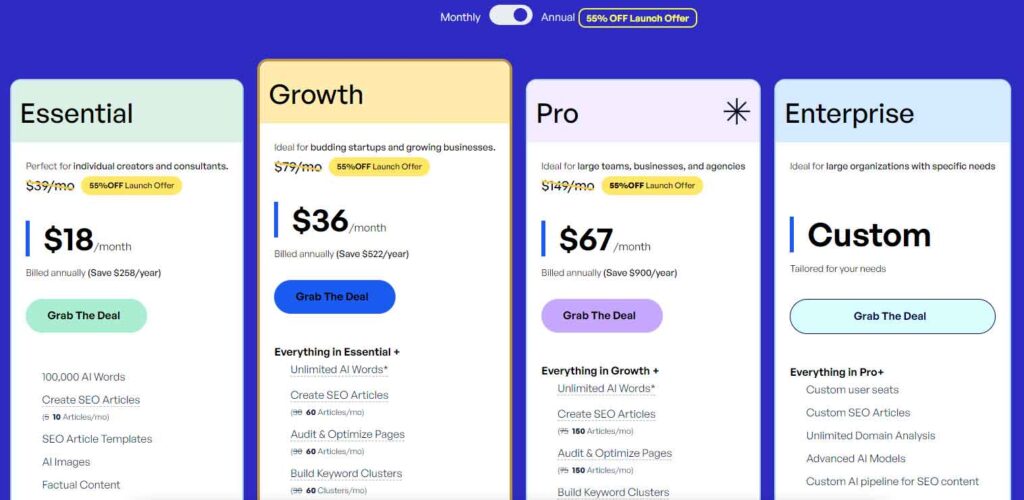
Scalenut offers a 7-day free trial, with pricing plans tailored to different needs:
1. Essential Plan
Priced at $39 per month (or $19 if billed annually), this plan is ideal for beginner bloggers and consultants. It provides access to 100k AI words and allows for 5 article generations per month. It suits those who prioritize other marketing channels and publish approximately one article weekly.
2. Growth Plan
At $79 per month (or $39 annually), the Growth Plan allows users to create 30 optimized articles monthly. It includes features such as auditing existing articles, keyword clustering, and various integrations. This plan is well-suited for most small businesses.
3. Pro Plan
The Pro Plan, priced at $149 per month (or $75 annually), offers affordability compared to similar SEO suite software tools. It accommodates larger companies or agencies, enabling the creation of up to 75 monthly articles optimized for search engines. Additionally, users gain access to Keyword Gap analysis, a dedicated support manager, and the ability to add another user.
Room for improvement
Even though AI evolves at an unprecedented rate, it’s still the early years, and every AI tool has areas for improvement. Here are a couple of negative points I noticed while using Scalenut:
1. Keyword clusters can be better
It seems that while Scalenut’s keyword clustering feature has potential, its current implementation may not fully meet the expectations of users seeking more refined and actionable insights. While the generation of numerous keyword clusters may seem impressive at first glance, the presence of a high number of single-keyword clusters could dilute the usefulness of the feature.
A more effective approach, as you suggested, would be to prioritize the generation of fewer clusters with a higher concentration of related keywords. This would enable users to focus their content creation efforts on topics with greater depth and relevance, ultimately contributing to the establishment of topical authority.
In summary, while Scalenut’s keyword clustering feature shows promise, there is room for improvement in terms of refining the output to provide users with more focused and actionable insights for content creation and optimization.
2. Keyword relevancy is off sometimes
It appears that many keyword research tools, including Scalenut, may sometimes present low-relevance keywords in their results, detracting from the overall usefulness of the data provided. In your example, when searching for “zero waste lifestyle,” the top results may include brand names like “Patagonia” or “Trader Joe’s,” which may not be directly relevant to the topic at hand.
While these keywords may have high search volumes, their relevance to a zero-waste website or content may be questionable. This discrepancy raises concerns about the accuracy of relevance assessments provided by the tool. Users may find it challenging to filter out irrelevant keywords and focus on those that are truly pertinent to their content strategy.
As a result, there is a need for keyword research tools to refine their algorithms to ensure that the keywords presented align more closely with the user’s search intent and content objectives. This would enable users to make more informed decisions when selecting keywords for their content optimization efforts.
3. No real personalization
It seems that while Scalenut has potential for personalization, the actual implementation may fall short of expectations. Despite providing examples of your tone and custom writing points, the AI-generated content did not reflect these inputs accurately.
Personalization is crucial for creating content that resonates with audiences and stands out in search engine rankings. However, if the AI tool fails to incorporate personal inputs effectively, it may result in generic content that lacks the unique voice, insights, and expertise necessary to differentiate itself in the crowded online space.
Improving the personalization capabilities of AI writing tools like Scalenut could lead to more tailored and impactful content, ultimately helping users achieve better results in their SEO and content marketing efforts.
Best Scalenut alternatives
While Scalenut shows promise as an all-in-one SEO platform, certain alternatives may be worth considering depending on specific needs. Here are some of the best Scalenut alternatives:
- MarketMuse is an excellent option for those primarily focused on SEO. It offers powerful keyword research capabilities, impressive competitive analysis, and unique data visualization for building a smart content strategy.
- Koala is the best option in 2024 for AI-generated articles. While its interface is not as robust for overall digital marketing needs, Koala makes up for it with good-quality outputs and useful features that make a lot of sense if you understand SEO.
- Neuronwriter is my first choice for optimizing content for search engines. It uses natural language processing for analyzing competitor articles that rank well and provides actionable tips for improving your content. It also now has a bunch of AI assistant features to streamline your article writing.
Final Verdict
It sounds like you appreciate Scalenut’s planning and research features, but you’re disappointed with the quality of the generated content. The lack of nuanced voice compared to top AI writing tools like Koala is a significant drawback for you.
While Scalenut may be user-friendly, you don’t believe it justifies its price tag unless there’s a significant improvement in content generation. In your view, Scalenut remains a useful time-saving SEO tool but falls short of being a fully reliable solution for content creation.